
Comments
0 Comments
Author
Sharath Kumar
Post Date
February 14, 2026
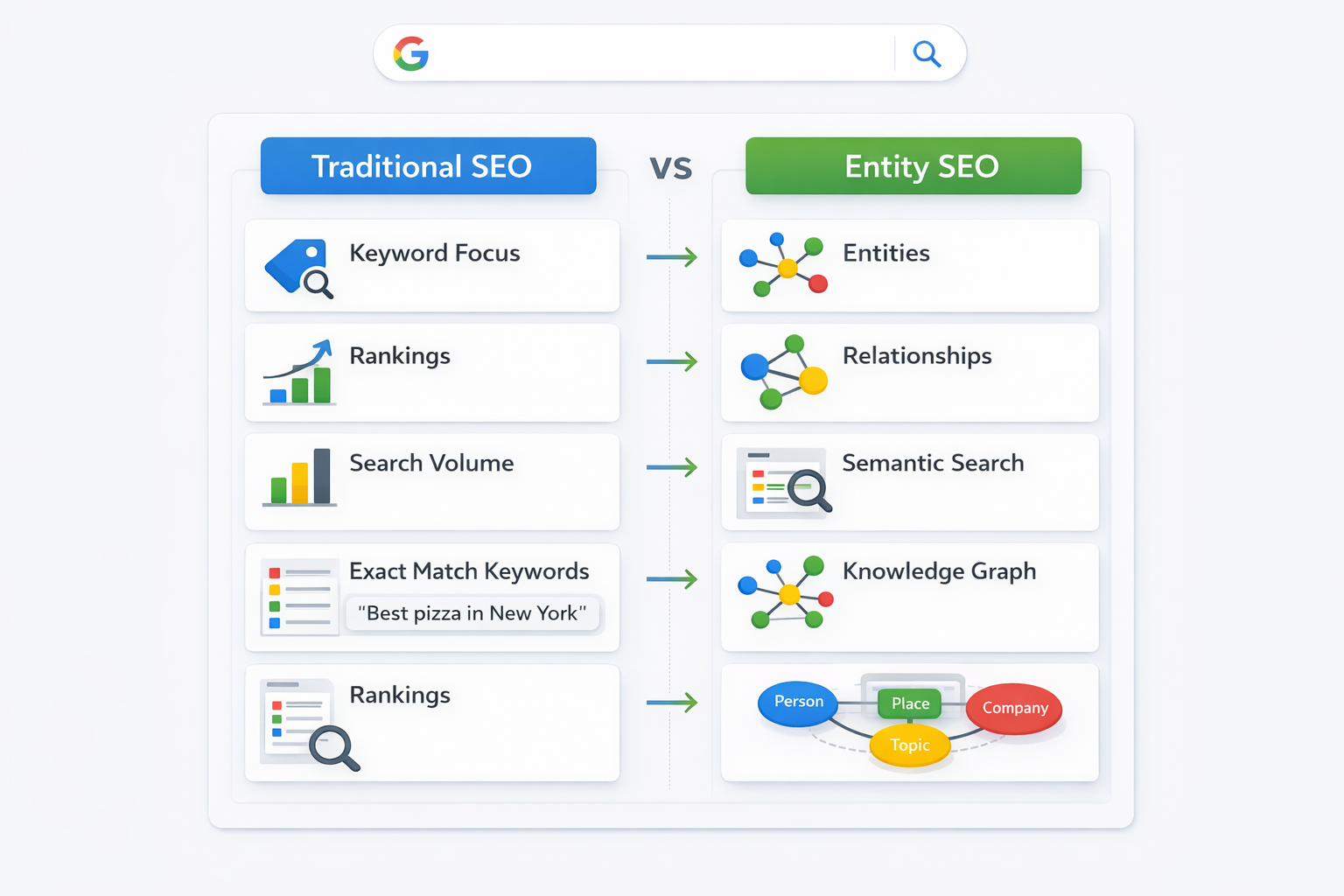
Understanding entity SEO has become critical for anyone serious about organic growth. While traditional SEO practitioners chase individual keywords, forward-thinking marketers are building topical authority through entities, semantic relationships, and knowledge-graph thinking the same way Google actually understands the web.
In this comprehensive guide, you’ll discover what entity SEO really is, how it fundamentally differs from traditional keyword-focused approaches, and why entity-optimized sites consistently outrank their competitors while surviving algorithm updates that devastate keyword-centric strategies.
Table of Contents
- What Is Entity SEO?
- How Entity SEO Differs from Traditional SEO
- Why Entity SEO Outperforms Keyword SEO
- Understanding Entities and Knowledge Graphs
- The Four Core Search Intent Types in Entity SEO
- Building Topical Authority with Entity Systems
- Entity SEO Implementation Framework
- Measuring Entity SEO Success
What Is Entity SEO?
Entity SEO is the practice of optimizing content, site architecture, and structured data around entities, their attributes, relationships, and search intent, so your site aligns with how modern search engines understand and retrieve information.
Unlike traditional SEO that asks “which keywords should this page rank for?”, entity SEO asks a fundamentally different question: “which thing is this page about, and how does it relate to other things?”
This isn’t just semantic wordplay. It represents a crucial mental shift that separates sites winning hundreds of long-tail queries from those stuck in keyword roulette.
What Counts as an Entity?
An entity is a uniquely identifiable thing that Google can understand and reference consistently across the web. Think of entities as the nouns of the internet things that exist independently and have distinct properties.
Examples of entities include:
- Concepts: Semantic SEO, topical authority, knowledge graphs
- Organizations: HubSpot, Google, Anthropic
- People: John Mueller, Rand Fishkin, Danny Sullivan
- Places: New York City, Silicon Valley, Times Square
- Products: MacBook Pro, iPhone 15, WordPress
When you publish content, Google’s systems identify which entities are mentioned, how they relate to each other, and how your content fits into what the search engine already knows. Your job in entity SEO is to make those answers crystal clear.
How Entity SEO Differs from Traditional SEO
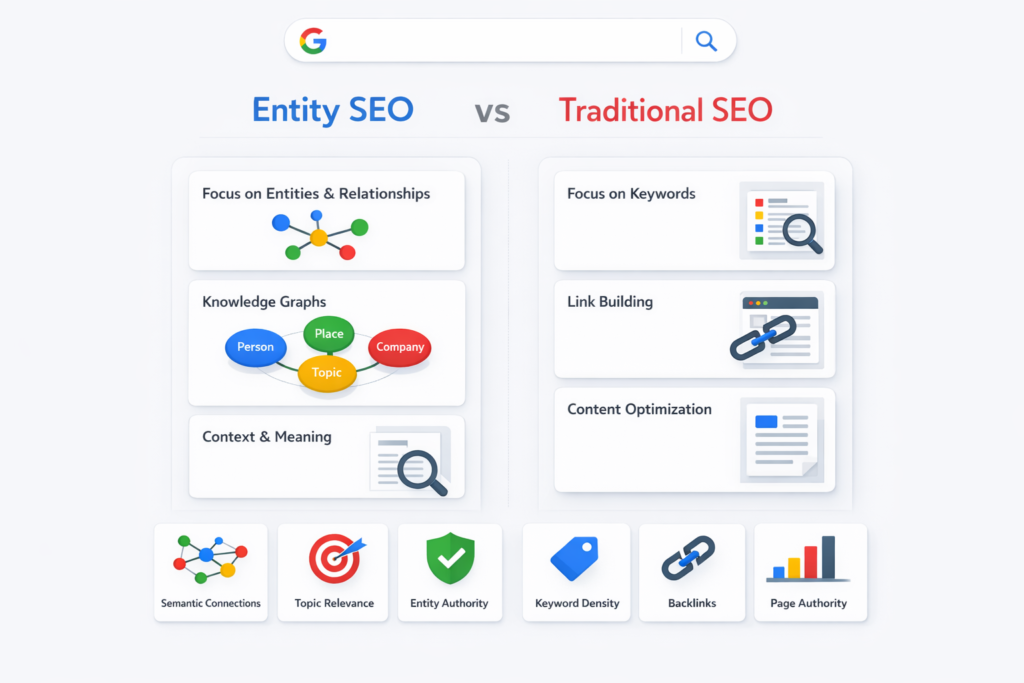
The differences between entity SEO and traditional keyword SEO run deeper than tactics, they represent completely different philosophies about how search works.
Traditional Keyword SEO Approach
Traditional SEO operates on string matching logic:
- Target specific keyword phrases
- Optimize for exact-match or close-variant keywords
- Track rankings for individual keyword positions
- Create separate pages for similar keyword variations
- Focus on keyword density and placement
This approach made perfect sense when search engines primarily matched query strings to document text. But that’s not how modern search works anymore.
Entity SEO Approach
Entity SEO operates on semantic understanding:
- Define the primary entity each page represents
- Identify secondary entities that provide context
- Build content around entity sets, not keyword lists
- Create topic clusters with clear hub-and-spoke architecture
- Establish relationships between entities through internal linking
- Use structured data to explicitly communicate entity information
The fundamental difference: keyword SEO tries to win queries; entity SEO wins topics.
A Practical Example
Imagine you want to rank for WordPress performance optimization.
Traditional keyword SEO approach:
- Create separate pages for “speed up wordpress,” “wordpress performance,” “fix slow wordpress site,” “wordpress optimization”
- Risk keyword cannibalization
- Dilute topical authority across multiple thin pages
Entity SEO approach:
- Create one comprehensive hub about the entity “WordPress Performance Optimization”
- Include secondary entities: caching, image optimization, database optimization, CDN, hosting quality
- Build supporting spokes for specific techniques aligned with different search intents
- Connect everything through semantic internal linking
The entity approach ranks for ALL the keyword variations naturally because Google understands the topic comprehensively, not because you matched exact strings.
Why Entity SEO Outperforms Keyword SEO
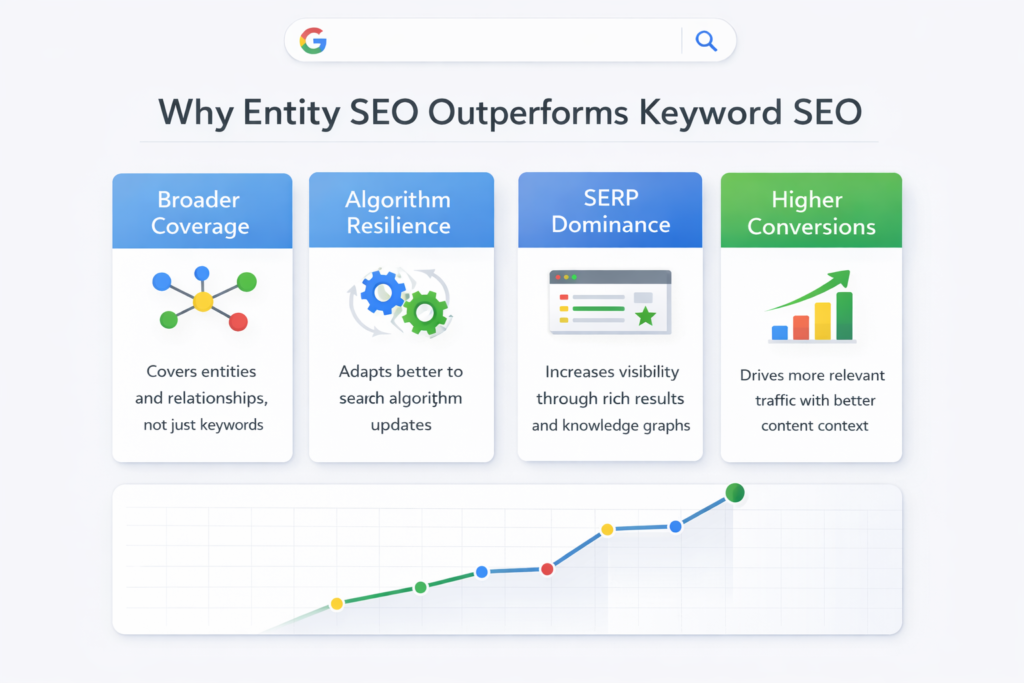
Sites optimized using entity SEO principles consistently demonstrate superior performance across multiple metrics:
1. Broader Keyword Coverage
Entity-optimized sites rank for hundreds of long-tail and conversational queries they never explicitly targeted. When you thoroughly cover a topic’s entity set, Google’s natural language processing identifies your relevance across countless query variations.
Think of it this way: “speed up wordpress,” “fix slow wp site,” and “improve wordpress performance” all represent the same underlying intent and entity relationship. Cover the topic thoroughly, and Google handles the phrasing variations automatically.
2. Algorithm Update Resilience
Sites built around entity SEO principles prove remarkably resilient to core algorithm updates that devastate keyword-focused competitors. Why? Because Google’s updates increasingly reward genuine topical authority and semantic coherence over keyword manipulation tactics.
3. SERP Feature Dominance
Entity-optimized content wins more featured snippets, People Also Ask (PAA) positions, and rich results. Structured data implementation combined with comprehensive entity coverage signals exactly what search engines need to confidently display your content prominently.
4. Higher Conversion Rates
When content aligns with both entity relationships AND search intent, visitors find exactly what they need. This intent clarity translates directly to better engagement metrics and higher conversion rates—not just more traffic, but more valuable traffic.
Understanding Entities and Knowledge Graphs
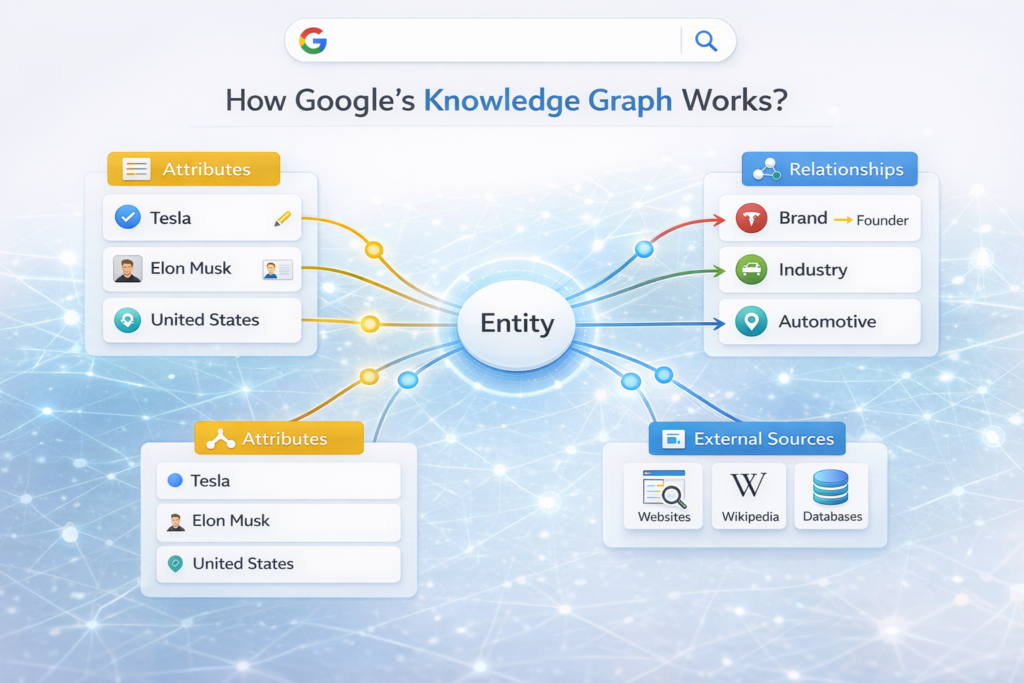
To implement entity SEO effectively, you need to understand how search engines model meaning through knowledge graphs.
Google’s Knowledge Graph Simplified
Think of Google’s knowledge graph as a massive database with three components:
- Nodes = entities (the things themselves)
- Edges = relationships (how things connect)
- Attributes = properties (descriptive information like name, type, sameAs)
When you publish content, Google’s systems perform three critical evaluations:
- Which entities are mentioned?
- How are they related?
- How does this content fit into what we already know?
Your entity SEO strategy should make these answers obvious through content structure, internal linking, and structured data.
How Google Processes Entity Content
Modern search engines use sophisticated natural language processing:
Named Entity Recognition (NER) identifies entities in your content Disambiguation decides which specific entity you mean when terms could refer to multiple things Embeddings evaluate semantic similarity rather than exact wording matches
This technology explains why the same page can rank for “semantic seo,” “entity-based optimization,” and “knowledge graph SEO” Google understands the semantic relationships, not just keyword matches.
Implication for content creators: Cover topics thoroughly using natural language. Google handles the phrasing variations.
The Four Core Search Intent Types in Entity SEO
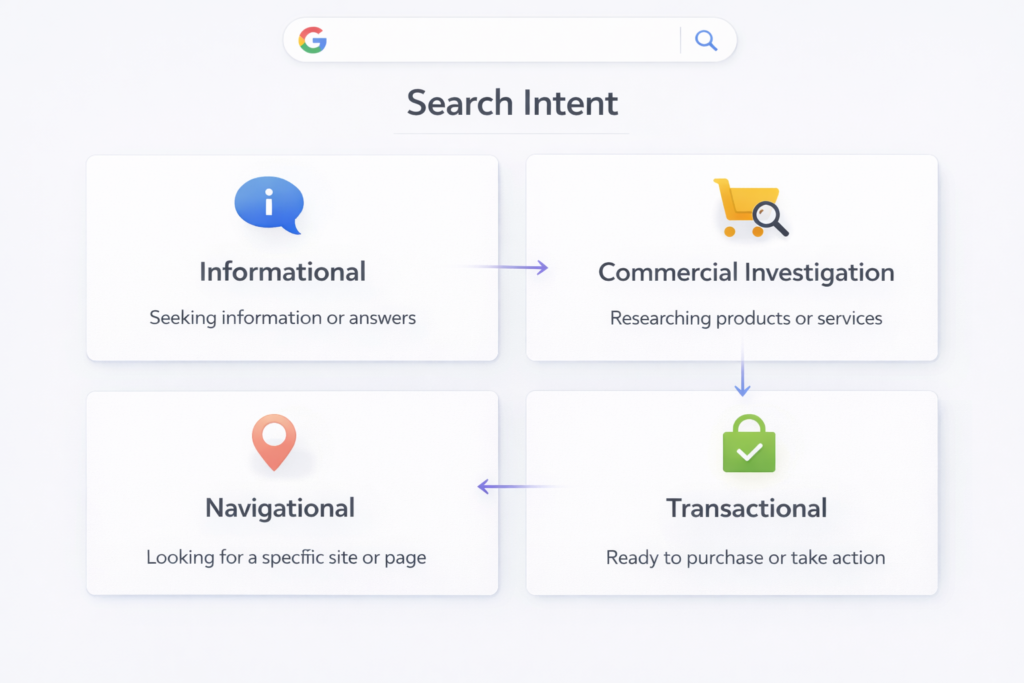
Entity SEO recognizes that search intent determines content format, depth, call-to-action, and internal linking role. Every entity can appear across multiple intent types, and trying to satisfy all intents on one URL represents a critical mistake.
1. Informational Intent
Users seek knowledge, definitions, or understanding. These queries typically include words like “what is,” “how to,” “guide,” or “explained.”
Entity SEO application: Create comprehensive hub content that establishes your authority on the primary entity while naturally incorporating related secondary entities.
2. Commercial Investigation Intent
Users are researching options before making decisions. They use terms like “best,” “vs,” “review,” “comparison,” or “alternatives.”
Entity SEO application: Build comparison content that clearly defines entity attributes and relationships while helping users evaluate options.
3. Transactional Intent
Users are ready to take action, purchase, signup, download, or contact. Keywords include “buy,” “pricing,” “order,” “get started.”
Entity SEO application: Create conversion-focused pages with clear entity definitions (what you’re offering) and prominent CTAs.
4. Navigational Intent
Users want to find a specific website, page, or brand entity.
Entity SEO application: Ensure brand entity consistency through structured data, optimized brand SERPs, and clear site architecture.
Remember: If entity SEO defines what the page is about, intent defines why it exists.
Building Topical Authority with Entity Systems
True entity SEO implementation requires shifting from individual page optimization to building interconnected topic systems.
From Keywords to Entity Sets
Instead of thinking “this page targets ‘semantic seo checklist,'” think:
- Primary entity: Semantic SEO
- Secondary entities: search intent, knowledge graph, structured data, topic modeling, internal linking, NLP, entity recognition
Each topic gets an entity set, not a keyword list.
Rule of thumb: Across a hub and its supporting content, cover 20% more relevant entities than competing top-ranking pages. But distribute entities naturally, cramming destroys readability and signals manipulation.
This is how topical authority is earned, not declared.
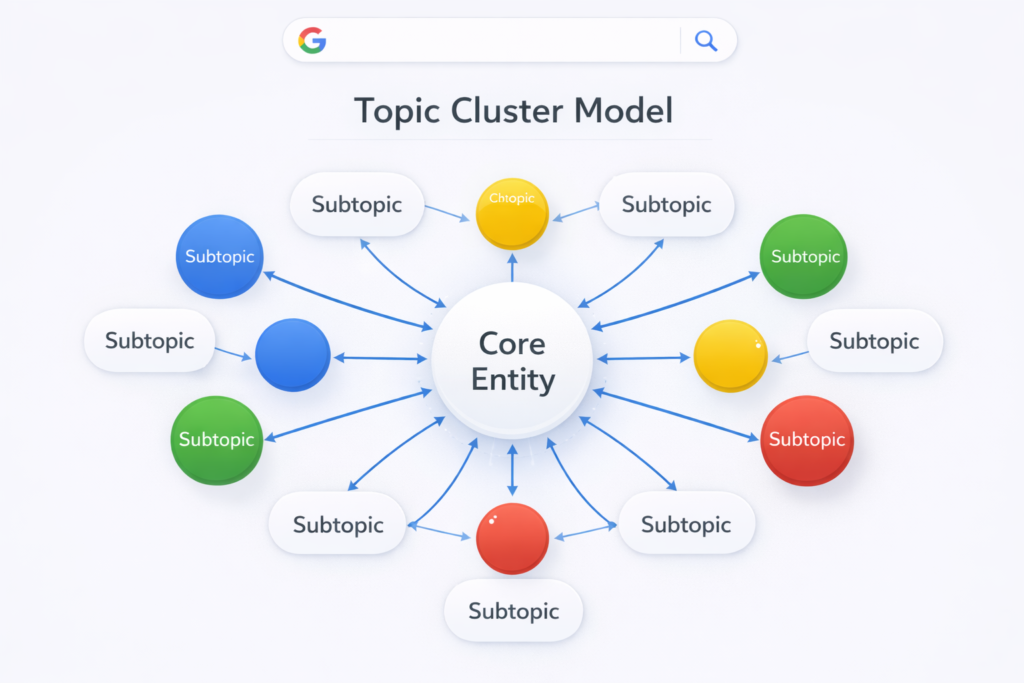
Content Hubs and Cluster Architecture
Think of your site as a mini knowledge graph where:
- Pages = nodes
- Internal links = edges
- Anchor text = relationship labels
A strong entity-based cluster includes:
- One clear hub page (comprehensive coverage of primary entity)
- Multiple intent-aligned spoke pages (detailed treatment of secondary entities)
- Dense, meaningful internal links (explicit relationship signals)
Thin, isolated posts weaken your knowledge graph. Every page should connect meaningfully to your topical architecture.
Topic Maps: Your Semantic Blueprint
Building effective entity SEO requires planning before publishing. A topic map answers: “What must exist on this site for Google to trust us on this topic?”
How to build a topic map:
- Choose your core entity
- Analyze top-ranking SERPs and People Also Ask results
- Extract recurring entities and questions
- Group content by intent and buyer journey stage
- Assign specific pages: hub, supporting articles, FAQs, transactional pages
This systematic approach eliminates guesswork and ensures comprehensive entity coverage.
Entity SEO Implementation Framework
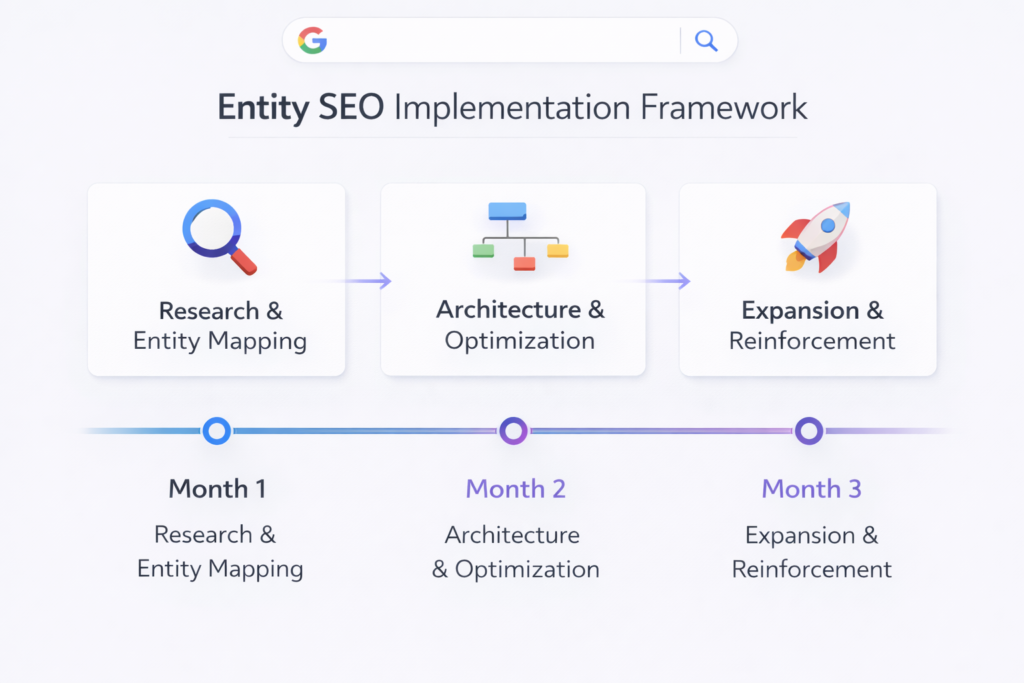
Ready to implement entity SEO? Follow this proven 90-day framework:
Month 1: Foundations
Week 1-2:
- Identify 3-5 revenue-critical entities your business should own
- Research entity relationships through SERP analysis and PAA mining
- Document current content against entity requirements
Week 3-4:
- Build detailed topic maps for each priority entity
- Audit existing content for gaps and cannibalization issues
- Create content briefs that specify primary and secondary entities
Month 2: Architecture and Optimization
Week 5-6:
- Launch new hub pages or significantly improve existing ones
- Implement or refine content cluster architecture
- Fix internal linking to create clear entity relationships
Week 7-8:
- Implement schema markup (Organization, Article, FAQPage, Product/Service)
- Optimize existing content to strengthen entity focus
- Add FAQ sections based on PAA research
Month 3: Expansion and Measurement
Week 9-10:
- Publish missing spoke content identified in topic maps
- Refresh temporal content where needed
- Build author and brand entities through consistent schema
Week 11-12:
- Measure cluster-level performance (not just individual pages)
- Identify quick wins for additional entity coverage
- Plan next-quarter entity expansion
Remember: Entity SEO isn’t a one-time project—it’s an ongoing systems approach to content and authority building.
Measuring Entity SEO Success
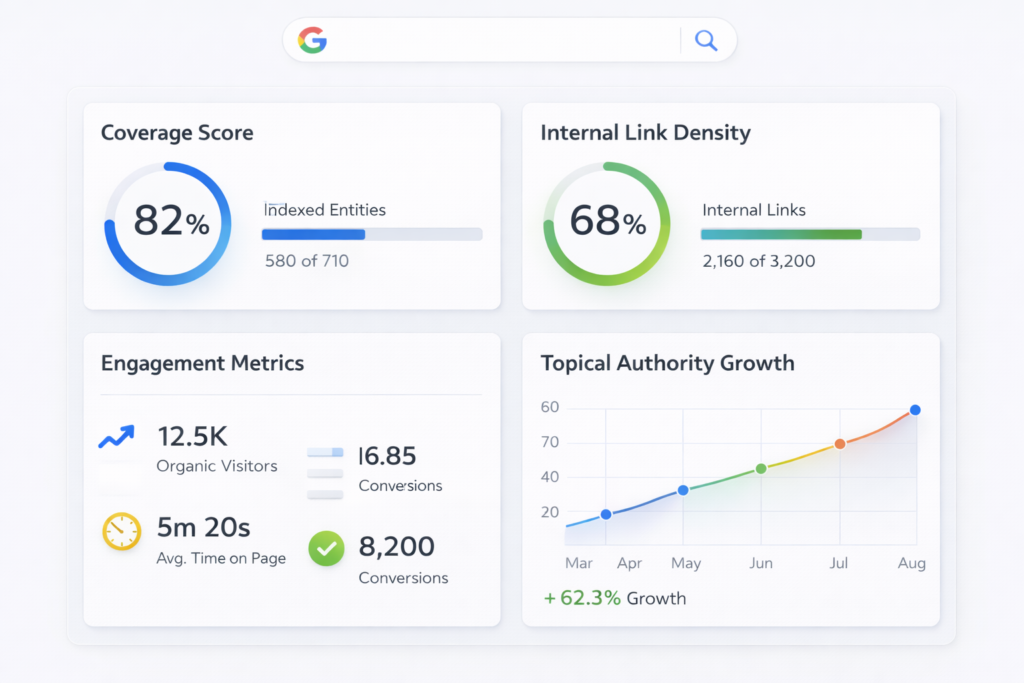
Traditional SEO metrics focus on individual page rankings. Entity SEO requires cluster-level measurement that reflects topical authority:
Coverage Score
Track what percentage of relevant entities you’ve addressed compared to top competitors. Tools like Google Search Console, combined with manual SERP analysis, reveal coverage gaps.
Internal Link Density
Measure how well-connected your entity clusters are. Strong entity architecture shows high internal linking between related pages with semantic anchor text.
Engagement Metrics
Entity-aligned content demonstrates higher time-on-page, lower bounce rates, and better scroll depth because it matches user intent and provides comprehensive answers.
Conversions Per Topic
Track conversions at the cluster level, not just individual pages. A well-optimized entity cluster generates compound value as users navigate between related content.
Keyword Expansion
Monitor how many additional keywords you rank for without explicitly targeting them. Entity SEO success appears as organic keyword growth beyond your initial targets.
Entity SEO success shows up as compounding growth, not isolated ranking wins.
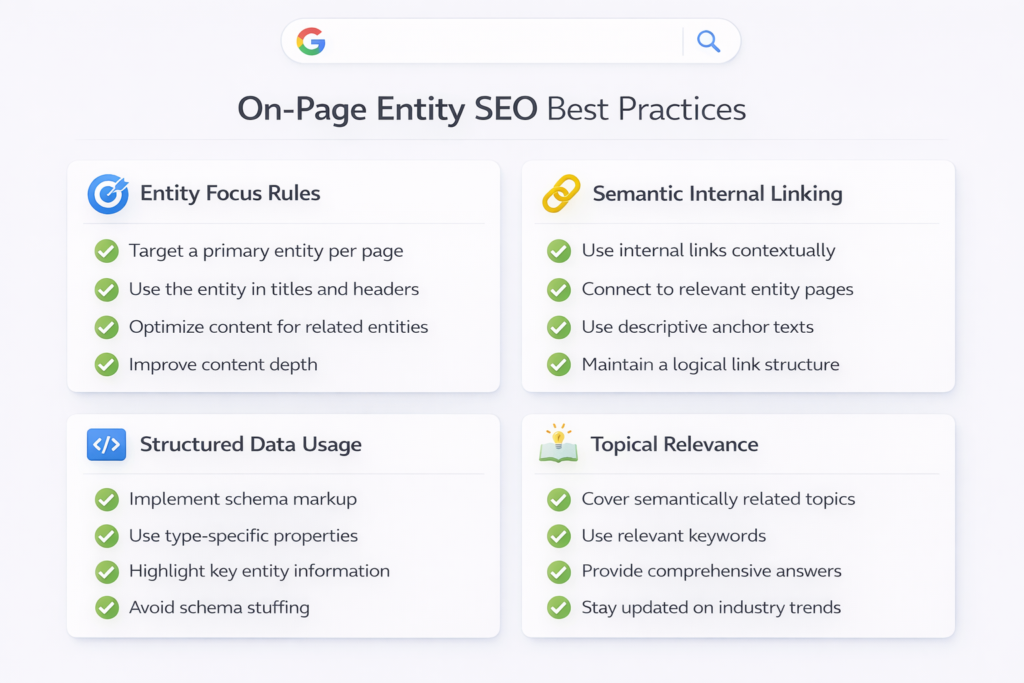
On-Page Entity SEO Best Practices
Every important page in your entity SEO strategy should follow these structural principles:
Entity Focus Rules
- One clear primary entity per page (prevents semantic cannibalization)
- 5-15 supporting secondary entities (provides context without dilution)
- H1 explicitly names the primary entity
- H2/H3 headings map to secondary entities and related questions
- First paragraph establishes context and defines the primary entity
Clarity beats cleverness. Search engines reward straightforward entity communication over creative but ambiguous content.
Semantic Internal Linking
Internal links function as semantic signals in entity SEO, not just navigation:
Best practices:
- Use descriptive, entity-rich anchor text (“entity SEO implementation” not “click here”)
- Always link spoke pages back to hub pages
- Create lateral links where context overlaps
- Avoid generic anchors that provide no semantic information
Every internal link tells Google about entity relationships. Make them count.
Structured Data as Explicit Entity Communication
Schema markup represents how you explicitly tell Google what entities exist on your page, not just show them through content.
Core schema types for entity SEO:
- Organization / LocalBusiness (brand entity)
- Person (author entities)
- Article / BlogPosting (content entities)
- Product / Service (commercial entities)
- FAQPage (question entities)
Use sameAs properties to connect your entities to authoritative external profiles (LinkedIn, Wikipedia, Wikidata, official social profiles). This disambiguation strengthens entity recognition.
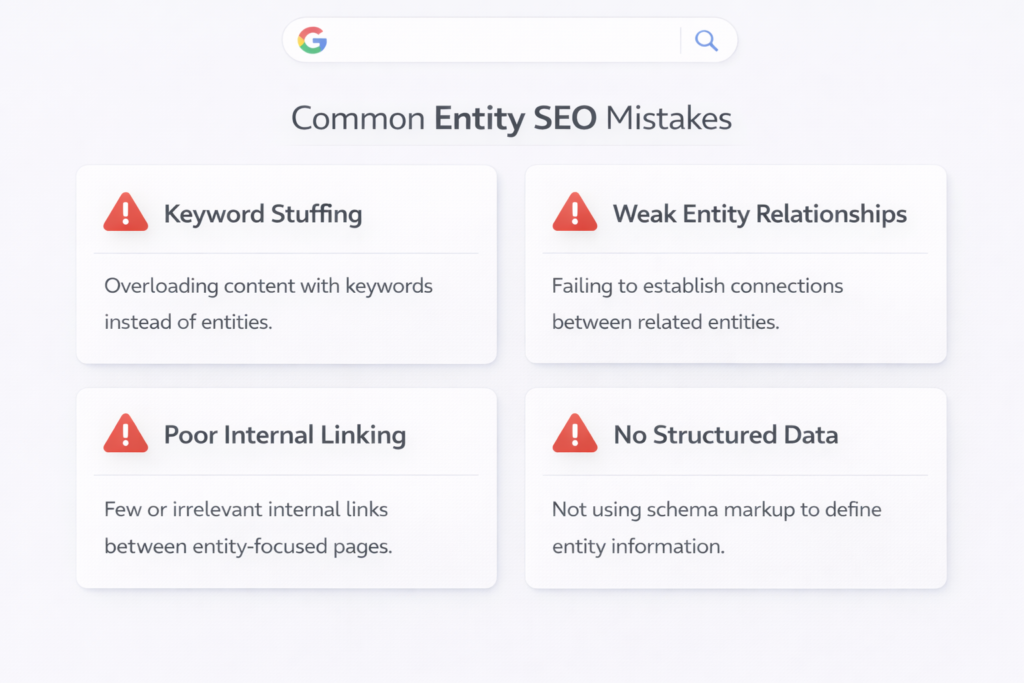
Common Entity SEO Mistakes to Avoid
Even SEO professionals transitioning to entity SEO make predictable mistakes:
Mistake 1: Trying to satisfy multiple intents on one page Solution: Create separate pages for distinct intents, properly interlinked
Mistake 2: Over-optimizing for one keyword instead of covering the entity set Solution: Identify 10-20 related entities and incorporate them naturally
Mistake 3: Building isolated content without cluster architecture Solution: Never publish without knowing where content fits in your knowledge graph
Mistake 4: Implementing schema markup inconsistently Solution: Systematically apply structured data across all content types
Mistake 5: Measuring success by individual page rankings Solution: Track cluster-level metrics and topical authority indicators
The Future Is Entity-Based
Search technology continues evolving toward deeper semantic understanding. AI-powered features like Google’s Search Generative Experience (SGE) and conversational search rely even more heavily on entity recognition and knowledge graph relationships.
Entity SEO isn’t a temporary tactic—it’s alignment with the fundamental direction of search technology.
Sites built on entity principles will:
- Adapt more easily to new search features
- Maintain rankings through algorithm updates
- Capture traffic from voice and conversational search
- Provide better user experiences through intent alignment
Start Your Entity SEO Transformation Today
The shift from keyword SEO to entity SEO represents the most significant evolution in organic search strategy since mobile optimization became mandatory.
You’re no longer optimizing pages for keywords—you’re building knowledge structures that search engines can trust.
Begin with these immediate actions:
- Choose one revenue-critical entity your business should dominate
- Analyze the top 10 results to extract the entity set Google expects
- Audit your existing content against entity coverage requirements
- Build a topic map showing hub, spokes, and entity relationships
- Implement schema markup to explicitly communicate entity information
The sites winning organic search in 2026 aren’t chasing keywords—they’re systematically building topical authority through entity SEO principles.
Will yours be one of them?
Related Resources:
- Google’s Introduction to the Knowledge Graph
- Schema.org Structured Data Documentation
- Google Search Console
About the Author: This guide draws from the Entity SEO Strategy Playbook (2026), a comprehensive resource for building topical authority using entities, search intent, and knowledge-graph thinking. Learn more about systematic approaches to modern SEO that prioritize semantic understanding over keyword manipulation.
